
Pre-Deployment Safety Testing Timelines for Frontier AI Models
According to public information, how long do external evaluators get access to frontier AI models before deployment?

From Claude Opus 4.6 research, with spotchecks and corrections. Please check the original sources if you need verified information.
According to public information, how long do external evaluators get access to frontier AI models before deployment? This document aims to answer this question. A few caveats:
Only entries with specific or approximate access durations are included.
Many models had external pre-deployment evaluations but no publicly disclosed testing duration, so the data below may not be representative of industry-wide practice.
Access times could be different where undisclosed.
Model checkpoints provided to pre-deployment evaluators could be meaningfully different from publicly deployed models.
“Access given 7 days before launch” does not imply that the evaluator had 7 days to evaluate the model.
Summary table
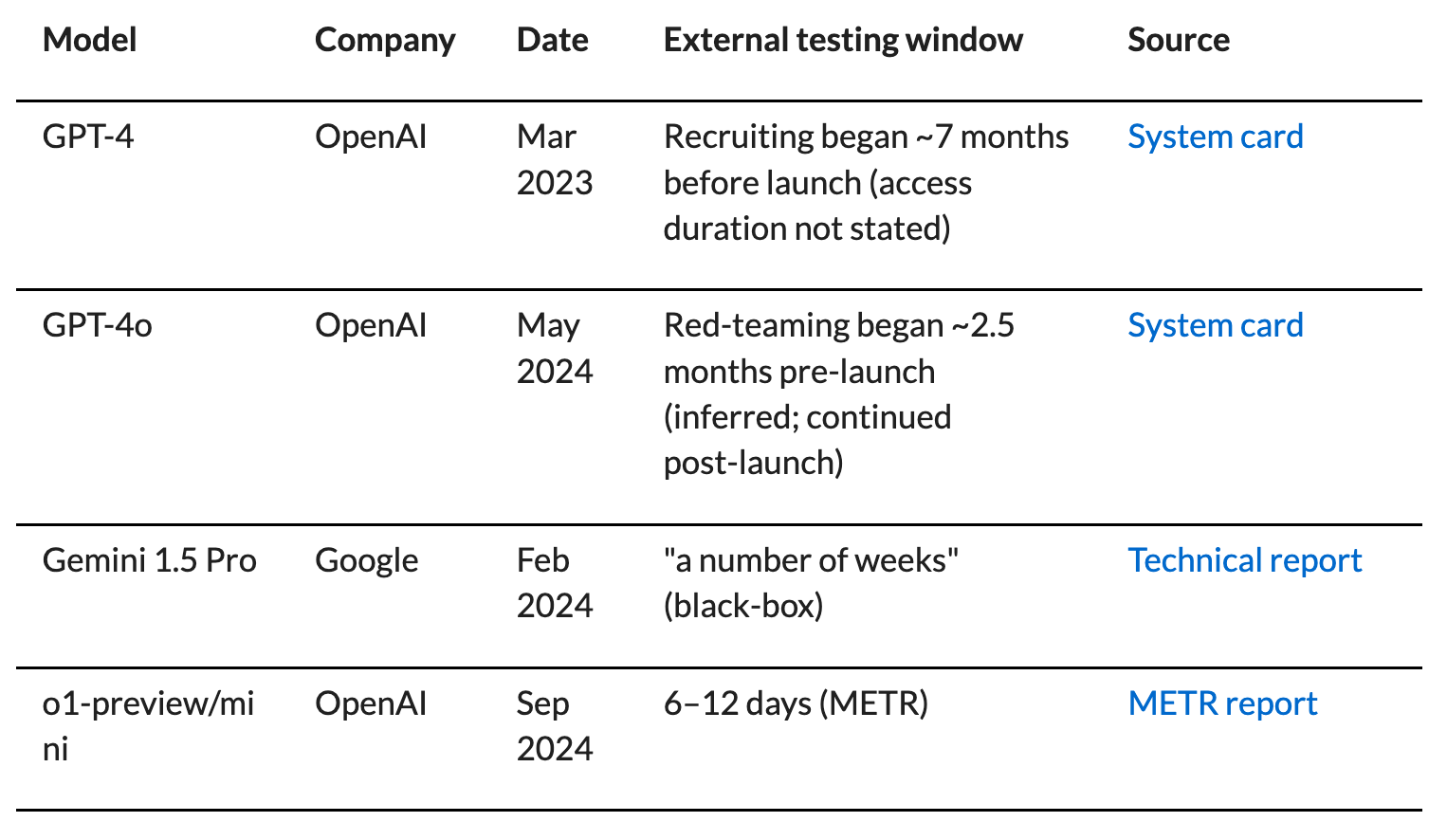
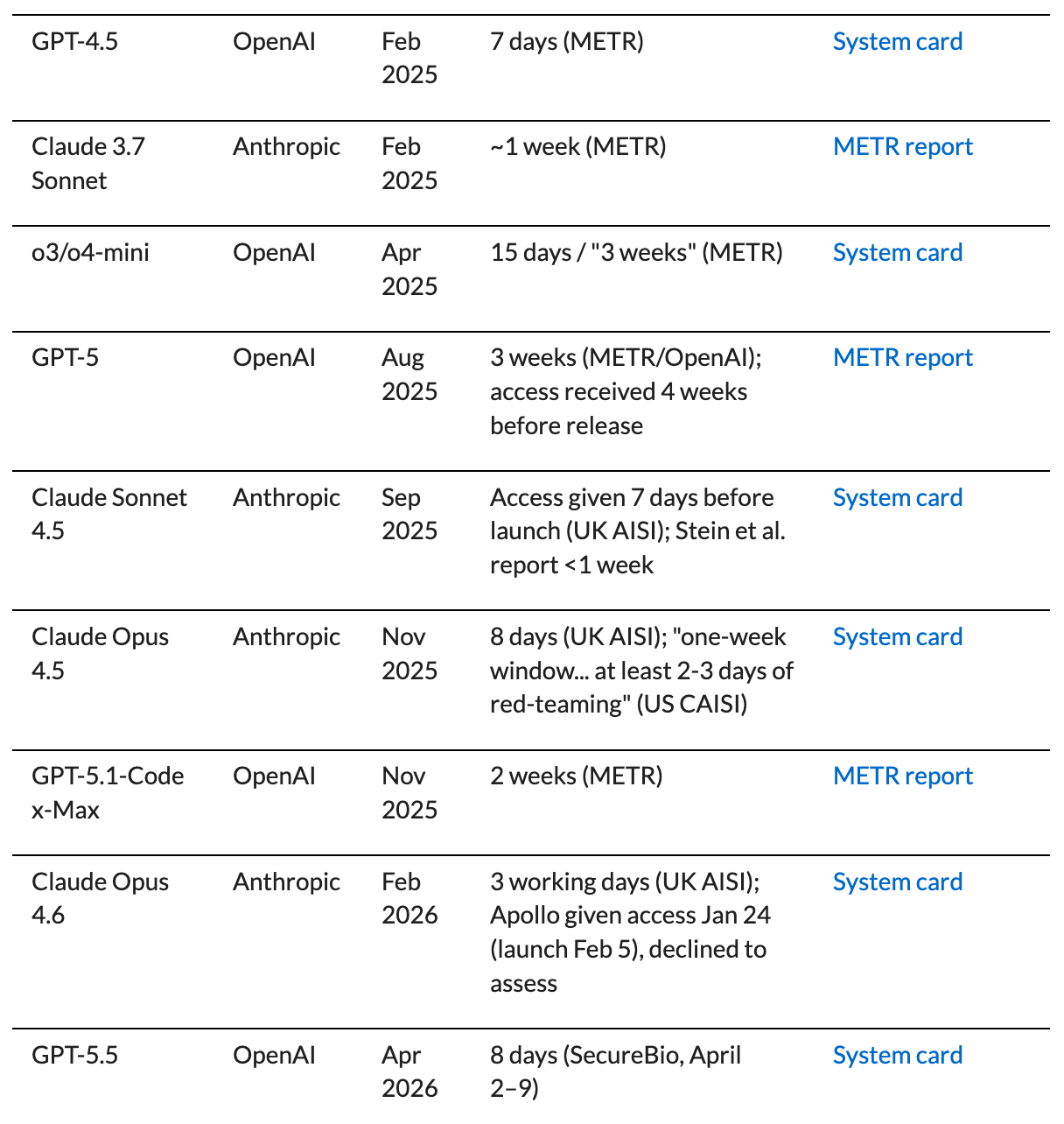
OpenAI
GPT-4 (March 2023): Recruiting began ~7 months before launch; access duration not stated. “In August 2022, we began recruiting external experts to qualitatively probe, adversarially test, and generally provide feedback on the GPT-4 models.” — System Card
GPT-4o (launched May 13, 2024): Red-teaming ran from early March through late June 2024; the ~2.5-month pre-launch portion is inferred, not a stated access duration. “Red teamers had access to various snapshots of the model at different stages of training and safety mitigation maturity starting in early March and continuing through late June 2024.” The pre-launch portion of this timeframe was approximately 2.5 months (early March to May 13), but this is inferred from the overall period and launch date; individual access durations are not stated. — System Card
o1-preview/mini (launched September 12, 2024): METR received access to o1-mini on August 28 (12 days before evaluations ended) and o1-preview on September 3 (6 days). All evaluations concluded September 9. “METR received access to OpenAI o1-mini on August 28th and to OpenAI o1-preview on September 3rd… evaluated these models for autonomous capabilities and AI R&D ability until September 9th.” — METR report
GPT-4.5 (February 2025): 7 days. “METR evaluated an earlier checkpoint of GPT-4.5 and was given access to that checkpoint for 7 days.” — System Card
o3/o4-mini (April 2025): 15 days (system card) / “three weeks” (METR). “This work spanned 15 days.” — System Card. “The work reported here was conducted over only three weeks.” — METR report
GPT-5 (August 2025): 3 weeks (METR/OpenAI); access received 4 weeks before release; 2 weeks (prompt-injection red team). “METR’s evaluation of GPT-5 took place over three weeks.” — METR report. “The Microsoft AI Red Team spent several weeks red-teaming gpt-5-thinking across multiple checkpoints” with 70+ experts — GPT-5 System Card. (Note: Microsoft is OpenAI’s largest investor, not an independent third party.) METR timeline: July 10 first checkpoint → August 1 preliminary results → August 7 release of GPT-5.
GPT-5.1-Codex-Max (November 2025): 2 weeks. “METR’s evaluation of GPT-5.1-Codex-Max took place over two weeks.” — METR report. November 4 first checkpoint → November 14 preliminary findings.
GPT-5.5 (April 2026): 8 days (SecureBio). “SecureBio assessed two pre-release checkpoints of GPT-5.5 using its biology and biosecurity evaluations, from April 2nd to 9th.” — System Card
Anthropic
Claude 3.7 Sonnet (February 2025): ~1 week (METR). “Most of the work reported here was conducted in a single week.” — METR report
Claude Sonnet 4.5 (launched September 29, 2025): UK AISI received access September 22, seven days before launch; Stein et al. report <1 week. “UK AISI was given access to [an early snapshot of Claude Sonnet 4.5] on September 22nd.” Apollo Research also received access; Stein et al. report that “Apollo and UK AISI received less than a week to evaluate Claude Sonnet 4.5.” Anthropic described the arrangement as “fairly short notice” with “very rapid turnaround.” — System Card; Stein et al., fn. 1
Claude Opus 4.5 (November 24, 2025): 8 days (UK AISI); “a one-week window, which included at least 2–3 days of red-teaming” (US CAISI). “Testing began on 13th November and lasted 8 days.” — System Card
Claude Opus 4.6 (February 5, 2026): 3 working days (UK AISI); “a one-week window” (US CAISI). Apollo Research received a first checkpoint on January 24 and a second on January 26; the system card does not state how long Apollo had access, and Apollo has indicated the actual testing window was shorter than the calendar gap to the February 5 launch. Apollo declined to issue a formal assessment: “Apollo expected that developing these experiments would have taken a significant amount of time, [so] Apollo decided to not provide any formal assessment of Claude Opus 4.6 at this stage.” — System Card
Google DeepMind
Gemini 1.5 Pro (February 2024): “a number of weeks.” “Our external testing groups were given black-box testing access to a February 2024 Gemini 1.5 Pro API model checkpoint for a number of weeks.” — Technical Report
Policy documents
EU GPAI Code of Practice (July 2025): “A period of at least 20 business days is appropriate for most systemic risks and model evaluation methods.” — Appendix 3.4
AEF-1 Standard (2025): “At least 20 business days are often necessary to carry out the various stages of evaluations when assessing substantially novel systems.” — AEF-1
Among recent models, GPT-5 apparently had the longest documented access window: METR received access on July 10, four weeks before the August 7 release. Their active evaluation work spanned 3 weeks, with preliminary results shared August 1. Whether access continued until release day is unclear from public information.