
Could G42 become a frontier AI developer?
An analysis of the UAE’s AI champion: its compute access, chip pipeline, model development track record, and the structural constraints that shape its trajectory. Claude-generated, not verified.

What is G42?
Group 42 (G42) is an Abu Dhabi-based artificial intelligence holding company founded in 2018 and chaired by Sheikh Tahnoon bin Zayed Al Nahyan, the UAE’s national security adviser and brother to the president. It operates through a constellation of subsidiaries: Core42 handles sovereign cloud and AI infrastructure, Inception builds AI models and products, Khazna runs data centers, and others focus on healthcare (M42), analytics (Presight), and space (Space42). The company operates in over 30 countries and has been backed by Mubadala Investment Company, Silver Lake ($800M minority stake in 2021), and most significantly, Microsoft ($1.5B investment in April 2024).
G42 is a signatory to the AI Seoul Summit’s Frontier AI Safety Commitments and has published a Frontier AI Safety Framework (developed with input from METR and SaferAI). It appears alongside Anthropic, OpenAI, Google DeepMind, and others in METR’s Common Elements of Frontier AI Safety Policies report.
Whether G42 could plausibly become a frontier AI developer depends on several intertwined factors: compute access, talent, research capacity, regulatory constraints, and strategic positioning.
The compute picture
Existing infrastructure: Condor Galaxy
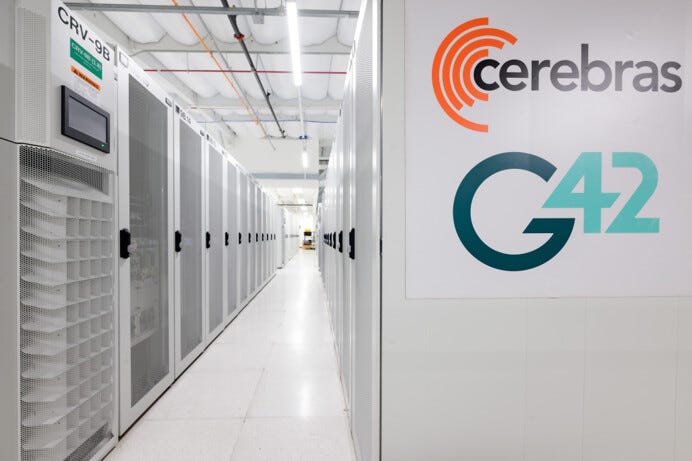
G42’s most established compute partnership is with Cerebras Systems, with which it co-developed the Condor Galaxy supercomputer network. The network launched in mid-2023 with Condor Galaxy 1 (CG-1), a 4 exaFLOP system with 64 Cerebras CS-2 nodes located in Santa Clara, California. CG-2 followed with equivalent capacity, and CG-3, announced in March 2024, uses 64 of Cerebras’ newer CS-3 systems to deliver 8 exaFLOPs, located in Dallas, Texas. The combined network reached 16 exaFLOPs as of the CG-3 announcement, with stated plans to eventually reach 36 exaFLOPs across nine interconnected systems. (Cerebras press releases; G42 CG-3 announcement)
Notably, the Condor Galaxy systems are located in the US, not the UAE. G42’s Jais models were trained on these US-based clusters.
GPU-based infrastructure
Beyond Cerebras, G42’s Core42 subsidiary operates GPU-based clusters. Its “Maximus-01” system, featuring over 9,000 AMD Instinct MI300X GPUs hosted at TeraWulf’s Lake Mariner facility in Buffalo, NY, secured a top-20 ranking on the global TOP500 supercomputers list with 114.5 petaflops of Linpack performance. Core42 describes three systems ranked on the TOP500, and its infrastructure spans locations in Abu Dhabi, France, California, Minnesota, Texas, and New York. (G42 TOP500 announcement)
The Core42 AI Cloud also offers NVIDIA H100 GPUs through a self-service portal. But these are for cloud customers, not necessarily for G42’s own frontier training runs. (G42 GITEX 2025 announcement)
Stargate UAE: the big bet
The headline infrastructure project is Stargate UAE, announced in May 2025 as a partnership between G42, OpenAI, Oracle, NVIDIA, Cisco, and SoftBank. The project is a 1-gigawatt AI compute cluster within a larger 5-gigawatt UAE-US AI Campus spanning approximately 10 square miles (19.2 square kilometers) in Abu Dhabi. (G42 Stargate announcement; The National, December 2025)
The first 200 MW phase is expected to go live in Q3 2026, with more than 5,000 construction workers and massive concrete and steel works already underway. The UAE’s AI minister has stated the full project will cost over $30 billion, well above initial estimates of roughly $20 billion. It will use NVIDIA Grace Blackwell GB300 systems. One source estimates approximately 100,000 chips powering around 1,400 servers, though it is unclear whether this figure refers to the initial 200 MW phase or the full 1 GW cluster. (The National, January 2026; Tech News Hub)
But here is the critical nuance: Stargate UAE is being built by G42 (via Khazna Data Centres) but operated by OpenAI and Oracle. It is part of the “OpenAI for Countries” initiative, designed so that nations can access OpenAI’s models through sovereign infrastructure. G42 is the builder and landlord, not necessarily the tenant training frontier models on the compute.
Chip access: the regulatory gauntlet
The November 2025 export approval
In November 2025, the US Commerce Department authorized G42 to purchase the equivalent of up to 35,000 NVIDIA Blackwell GB300 chips. Saudi Arabia’s HUMAIN received an equivalent allocation. This was a significant milestone; Mubadala CEO Khaldoon Al Mubarak described it as going from “a speed of 5km an hour to about 250km an hour,” noting the UAE previously had only a “couple of thousand” chips. (CNBC, November 2025; The National, November 2025; The National, December 2025)
G42 CEO Peng Xiao confirmed in February 2026 that chip shipments from NVIDIA (and also AMD and Cerebras) would arrive “within months” to support the initial 200 MW of Stargate capacity. (Data Center Dynamics, February 2026)
The broader UAE deal
The 35,000-chip authorization for G42 is separate from a broader US-UAE agreement allowing up to 500,000 advanced NVIDIA chips per year to flow to the UAE, announced during Trump’s May 2025 Gulf visit. However, initial export licenses excluded G42, going only to American companies operating data centers in the UAE (like Microsoft and Oracle). Under the broader arrangement, G42 is slated to receive 20% of AI processors destined for the UAE over time. (Tom’s Hardware, October 2025)
Strings attached
These chips come with extensive conditions. The export approval requires G42 to operate within a “Regulated Technology Environment” (RTE), a compliance framework developed jointly with the US and UAE governments and approved under Bureau of Industry and Security (BIS) guidelines. Key requirements include:
Physical security: verifying geolocation and physical control of regulated hardware
Personnel screening: individuals from countries under US arms embargo (Group D:5, including China) are barred from accessing the chips or facilities; Chinese nationals cannot work at the data centers
Use restrictions: chips cannot be used for AI model training by personnel associated with the Chinese government or organizations headquartered in China
Continuous monitoring: cryptographic mechanisms to track compute utilization, enabling token-level verification of AI workloads
Transparency: a “Common Operating Picture” providing continuous, verifiable visibility into chip deployment and use
(Network World; Axios, December 2024; Semafor, October 2025; G42 Assurance Compute Framework)
In February 2026, G42 announced its Assurance Compute Framework for the Pax Silica ecosystem, the US-led coalition (joining the UK, Japan, South Korea, Australia, Israel, Singapore, and others) aimed at securing AI supply chains. The framework is designed as a “replicable blueprint” for other partner countries. US officials have praised the approach, describing it as creating transparency so “American policymakers [can] have total transparency and assurance that the clusters in the UAE used and owned by G42 are not being accessed improperly.” (AGBI, February 2026)
What this means for frontier training
The export conditions do not explicitly prohibit G42 from training its own models on these chips. But the compliance overhead is substantial, the monitoring is intrusive, and the political fragility is real. Some Trump administration officials reportedly pushed to cut off direct chip access to G42 entirely, preferring to route everything through American companies. The deal’s finalization was repeatedly delayed over these concerns. (Wall Street Journal, via Wikipedia; Tom’s Hardware)
Moreover, Democrats in Congress have scrutinized potential conflicts of interest, noting that Aryam Investment (linked to G42 chairman Sheikh Tahnoon) purchased 49% of World Liberty Financial, a Trump family cryptocurrency venture, shortly before the chip export approvals. (AGBI, February 2026)
Current AI model development: Jais and beyond
G42’s most prominent model development effort is Jais, a bilingual Arabic-English large language model family developed through its subsidiary Inception in partnership with the Mohamed bin Zayed University of Artificial Intelligence (MBZUAI) and Cerebras Systems.
Jais 1 (August 2023): 13B parameter model trained on 395B tokens (116B Arabic, 279B English) on Condor Galaxy 1. (Cerebras press release)
Jais 30B (November 2023): trained on 427B tokens (126B Arabic, 251B English, 50B code). (G42 Jais 30B announcement)
Jais 70B and model family (mid-2024): 20 open-source models from 590M to 70B parameters, trained on up to 1.6T tokens. The 70B model was adapted from Llama-2 via continuous training on 370B tokens (330B Arabic). (Middle East AI News)
Jais 2 (December 2025): rebuilt from scratch at 8B and 70B sizes with redesigned architecture and better Arabic corpus. Trained end-to-end on Cerebras wafer-scale clusters, with inference running at 2,000 tokens/second. Achieved state-of-the-art on the AraGen Arabic leaderboard. (Cerebras Jais 2 blog; MBZUAI announcement)
Other models include Med42, a clinical LLM trained on Condor Galaxy 1 (reportedly trained in a weekend), and smaller code-focused models like Crystal-Coder-7B and BTLM-3B-8K.
G42 has also partnered with external model developers. In May 2025, G42 and Mistral AI announced a strategic partnership to co-develop AI platforms spanning model training, agents, and infrastructure. In February 2026, Semafor reported that OpenAI is working with G42 to build a fine-tuned version of ChatGPT for the UAE, using post-training techniques to adapt for Arabic dialects and local content policies. Core42 also deployed OpenAI’s open-weight models (gpt-oss-20B and gpt-oss-120B) on its AI Cloud platform. (Mistral partnership; Semafor, February 2026; Core42 OpenAI deployment)
Assessment: can G42 reach the frontier?
Arguments for
Capital is not the constraint. G42 is backed by one of the world’s richest sovereign wealth ecosystems. The Stargate UAE campus alone is expected to cost over $30 billion. The broader UAE-US AI partnership involves potential chip purchases worth hundreds of billions over the coming decade. Capital scarcity, which limits many aspiring AI developers, does not obviously apply here.
Chip access is arriving, though the gap with frontier labs is enormous. To put G42’s compute in context, here is a rough comparison of GPU-scale resources as of early 2026:
xAI (Colossus): ~200,000 H100/H200 GPUs operational at its Memphis site as of mid-2025, with 550,000 Blackwell GB200/GB300 chips planned for Colossus 2 (targeting early-mid 2026). Total site capacity being expanded toward 2 GW and an eventual target of 1 million GPUs. (xAI Colossus page; Introl blog, January 2026)
OpenAI: was on track to bring “well over” 1 million GPUs online by end of 2025, per Sam Altman. Its 10 GW Stargate buildout with NVIDIA would involve 4 to 5 million GPUs once fully deployed. OpenAI spent roughly $5 billion on R&D compute (training + research) in 2024 alone. (CACM, November 2025; CNBC, September 2025; Epoch AI)
Meta: aimed for 350,000 H100 GPUs (equivalent to ~600,000 H100s including other hardware) by end of 2024, and announced $66-72 billion in AI infrastructure spending for 2025. Its planned New Albany, Ohio campus alone targets 500,000 GB200/GB300 chips. (Meta engineering blog; CACM; Epoch GPU clusters data)
Google: has deployed millions of liquid-cooled TPUs across multiple gigawatt-scale campuses, with $85 billion budgeted for AI infrastructure in 2025. Google pioneered multi-datacenter training and has gigawatt-scale training capability across Iowa/Nebraska and Ohio campuses. (SemiAnalysis, September 2024; CACM)
G42: The authorized 35,000 GB300-equivalent chips have not yet been delivered (shipments expected “within months” as of February 2026). Its existing operational GPU fleet includes 9,000+ AMD MI300X GPUs (the TOP500-ranked Maximus-01 cluster) and access to Condor Galaxy’s 16 exaFLOPs of Cerebras wafer-scale systems. The UAE previously had only “a couple of thousand” advanced chips total, per Mubadala’s CEO. Beyond the 35,000-chip direct authorization, G42 is slated to receive 20% of the broader 500,000-chip annual flow to the UAE. It is not entirely clear whether the 35,000 authorization counts against the 20% allocation or is separate; if separate, G42’s ceiling could be roughly 135,000 Blackwell-equivalent chips in the first year, though achieving the full pipeline requires the broader UAE deal to be fully operational. Even at the upper end, that is roughly comparable to where xAI’s Colossus Phase 1 was in late 2024, and perhaps 10-20% of the scale at which the leading labs are currently operating or planning.
The compute gap is not a matter of being slightly behind. Frontier training runs in 2025-2026 are using clusters of 25,000-100,000+ GPUs for single training runs. G42’s authorized chip allocation would allow it to assemble a cluster in that range, but it would be using its entire allocation for a single run, leaving nothing for inference, experimentation, or parallel research. The leading labs have fleets many multiples larger, allowing them to run multiple large experiments concurrently, which is essential for the iterative research process that frontier development depends on.
Institutional partnerships are strong. Working relationships with OpenAI, Microsoft, Cerebras, Mistral, NVIDIA, and others provide technology transfer, knowledge spillovers, and operational experience that G42 would struggle to build independently.
Regional model leadership is real. The Jais family is the strongest Arabic LLM ecosystem available, and its open-weight release strategy has built a genuine developer community. This gives G42 a niche advantage in Arabic and multilingual AI that Western frontier labs largely ignore.
Research adjacency exists. MBZUAI provides a research partner specifically focused on AI, and G42’s Inception subsidiary has published technical work. The Cerebras partnership in particular gives access to ML training methodologies that are somewhat distinct from the NVIDIA GPU ecosystem most frontier labs depend on.
Arguments against
The models are not close to frontier scale. Jais 2’s 70B parameter models are competitive for Arabic, but they are roughly the size of Meta’s Llama-2 70B, which is now two generations behind the frontier. Current frontier models (GPT-4-class and beyond) reportedly use trillions of parameters or equivalent effective compute via mixture-of-experts, extended training, and novel architectures. Jais 2 was explicitly positioned as a “sovereign AI blueprint,” not a frontier capability push. The Cerebras blog for Jais 2 described it as achieving state-of-the-art quality “using only a fraction of compute used to train similar-sized models in the past,” which is an efficiency story, not a frontier-pushing story.
Stargate UAE is for OpenAI, not for G42. The clearest reading of the Stargate UAE project is that G42 is building and hosting infrastructure that OpenAI and Oracle will operate. OpenAI has described it as the “first milestone in our OpenAI for Countries initiative.” G42’s role is more analogous to a hyperscaler or data center operator than a frontier model developer in this context. The compute exists in the UAE, but G42 does not obviously get to use it all for its own frontier training runs.
The talent gap is significant, and it’s not clear money alone can close it. Could G42 just hire frontier-caliber researchers if it decided to? In principle, yes, the capital is there. G42 offers tax-free compensation in Abu Dhabi, and the UAE’s sovereign-backed entities have shown willingness to pay premium salaries. But several structural factors work against this:
First, the relevant talent pool is extremely small. The number of people who have hands-on experience training models at frontier scale (100K+ GPU runs, managing training stability, designing novel architectures, running large-scale RLHF/RLAIF pipelines) is probably in the low hundreds globally. These people are concentrated at OpenAI, Google DeepMind, Anthropic, Meta FAIR, and xAI, mostly in the Bay Area and London. Based on industry reporting and compensation data sites, they are already extraordinarily well-compensated, with total comp packages at senior research levels reportedly reaching $1M+ and sometimes much higher at the top end.
Second, and probably more importantly, frontier AI researchers generally want to work where the action is. The appeal of working at Anthropic or OpenAI or DeepMind is not primarily salary; it is access to the largest training runs, the best colleagues, and the ability to shape the most consequential technology of the era. Abu Dhabi, whatever its other attractions, is not the Bay Area or London in terms of research ecosystem density. G42’s own talent report (published April 2025 with Semafor) found that research-focused AI professionals prioritize “autonomy and global exposure” over compensation, which aligns with this dynamic. Relocating to Abu Dhabi represents a significant professional and personal bet that most top-tier researchers have little reason to take unless they believe the research environment itself will be world-class.
Third, frontier model development is not just about individual hires. It is about organizational knowledge: institutional memory about what works at scale, accumulated debugging intuition for training instabilities, internal codebases for distributed training, evaluation infrastructure, and the iterative culture of running and learning from many experiments in parallel. This is the kind of thing that takes years of operation at frontier scale to build up. You cannot simply assemble a team of brilliant individuals and immediately replicate OpenAI’s or DeepMind’s research pipeline. DeepSeek’s success in China is sometimes cited as a counterexample, but DeepSeek appears to have drawn on a deep Chinese ML research ecosystem and on researchers with substantial experience at relevant scale.
Fourth, G42’s current hiring profile does not suggest a frontier research push. A scan of its LinkedIn job postings as of early 2026 shows roles like “Senior Data Scientist (Machine Learning),” “Senior Data Scientist (Computer Vision),” and “Senior Applied Scientist,” which are applied ML roles, not frontier pre-training research positions. Levels.fyi data puts G42’s total compensation for software engineers at roughly $100K (AED 360K), which is competitive for Abu Dhabi but well below Bay Area frontier lab compensation. There is no public evidence of G42 hiring prominent ML researchers away from leading labs.
That said, there are scenarios where the talent picture could change. If frontier development becomes substantially more automatable (i.e., if AI systems can meaningfully contribute to architecture search, hyperparameter tuning, and training run management), the talent bottleneck could loosen. G42 would then need fewer world-class researchers and more competent engineers who can operate well-designed systems at scale, which is a talent profile it is better positioned to attract. MBZUAI also represents a long-term bet on growing local research capacity. But for now, the talent constraint is real and probably the most important barrier between G42 and genuine frontier status.
Does this match G42’s actual business desires? This is the key question. The evidence suggests that G42’s revealed preferences point more toward being an infrastructure and deployment platform than a frontier research lab. Its biggest projects (Stargate UAE, Core42 AI Cloud, Pax Silica compliance framework, partnerships with OpenAI and Mistral) are all about hosting, deploying, and adapting other people’s frontier models, not about building its own. The Jais models, while impressive for Arabic, are positioned as “sovereign AI” and regional specialization, not as bids for the general-purpose frontier. The company’s business model appears to be more like “AWS for the Global South and Middle East, with some in-house models” than “the next Anthropic.” If that is the strategy, the talent gap matters less, because the talent required to run a world-class cloud infrastructure and fine-tune existing models is quite different from (and more available than) the talent needed to push the frontier.
Export controls create structural dependence. G42’s compute access is contingent on US approval and ongoing compliance. The RTE framework, while politically useful, makes G42’s operations subject to continuous US oversight, including token-level verification of workloads. This is a fundamentally different position from that of an American frontier lab. If US-UAE relations deteriorate, or if a future administration takes a harder line, G42 could face restrictions that would be devastating to frontier training ambitions. The company’s history with Chinese firms, even though it has divested, continues to draw congressional scrutiny and creates political risk.
China divestment severed a potential alternative path. G42 previously had deep Chinese partnerships, including with BGI Group, SenseTime, Huawei, and others. Cutting these ties was necessary to maintain US chip access, but it also closed off an alternative compute and technology pipeline. G42 is now firmly in the US technology orbit, which provides access to the best hardware but also subjects it to the constraints of US export policy. There is no hedge.
The “sovereign AI” framing suggests a different goal. Much of G42’s public messaging, and the UAE government’s broader AI strategy, emphasizes “sovereign AI”: the ability for nations to run AI infrastructure on their own terms, with their own data, under their own laws. This is a legitimate and important goal, but it is a different goal from pushing the frontier of model capabilities. Sovereign AI is about deploying and fine-tuning existing frontier models (like OpenAI’s), not necessarily about training new ones that surpass them. The OpenAI partnership, the Mistral partnership, and the ChatGPT fine-tuning project all fit this mold.
Bottom line
G42 is not currently a frontier AI developer, and the most likely near-term trajectory is that it remains something different: a massive AI infrastructure player, a regional model leader (especially for Arabic), and a sovereign deployment partner for Western frontier labs. This is probably also what it wants to be, at least for now.
On compute, G42 is roughly one to two orders of magnitude behind the leading frontier labs in terms of GPU fleet size, and even its authorized chip pipeline would only bring it to the scale where a single frontier training run would consume its entire allocation. This is a serious constraint, but it is a constraint that could change: if the US-UAE chip pipeline scales as planned (up to 500,000 chips/year to the UAE, with 20% for G42), the compute picture could look very different by 2028.
On talent, the gap is probably more important and harder to close with capital alone. Frontier ML research talent is geographically concentrated, professionally motivated by access to the biggest runs, and embedded in organizational cultures that have accumulated years of institutional knowledge about training at scale. G42 could try to buy its way in, but the evidence suggests it is not currently trying. Its hiring profile, model development strategy, and partnership structure all point toward a company that has decided (for now) that hosting and deploying frontier models is a better bet than building them.
It is worth watching for signs that this changes: poaching prominent ML researchers from frontier labs, publishing novel architecture papers, or announcing pre-training runs at scales substantially beyond 70B. Absent those signals, the more plausible reading is that G42’s comparative advantage lies in infrastructure, deployment, and regional specialization rather than in pushing the state of the art.
The wildcard is how AI development itself evolves. If frontier development becomes substantially more automatable, or if the value of domain-specific frontier models (Arabic, healthcare, energy) rises relative to general-purpose frontier models, G42’s combination of capital, compute, and domain expertise could become more relevant. The company is positioning itself to be ready if that window opens.
Analysis based on publicly available sources as of late March 2026. Key sources include G42 press releases, CNBC, The National (UAE), Data Center Dynamics, Semafor, Axios, Tom’s Hardware, Cerebras press releases, MBZUAI announcements, and METR’s Common Elements report.